 Email
Email Google Scholar
 Semantic Scholar
 ORCID
ORCID Scopus
 ResearchGate
 dblp
dblp Github
 LinkedIn
 Zhihu
Zhihu 小红书
小红书Selected Projects
MadDE-NDA: Collision-Free Time-Optimal Planning of Underwater Gliders in Time-Varying Currents via Adaptive Niching Dual-Archive Differential Evolution
We propose a highly efficient GPU-accelerated 4D path planning framework for Autonomous Underwater Gliders (AUGs) operating in complex, time-varying ocean currents. To overcome the curse of dimensionality inherent in long-range missions, we introduce a fixed-dimensional B-spline trajectory encoding. Dynamic feasibility is strictly verified through RK4 integration, while continuous-domain collision safety over complex seabed topography is guaranteed using an ESDF-based Sphere Tracing strategy, eliminating the tunneling effect seen in traditional discrete sampling.
To tackle the highly multimodal search landscape induced by ocean currents and terrain, we develop a novel optimizer named MadDE-NDA (Niching Dual-Archive). It features dual cooperative archives to balance quality retention and diversity preservation, coupled with a stagnation-triggered niching mechanism. Accelerated by massive GPU parallelism for population-level evaluation, the framework demonstrates superior safety, efficiency, and robustness in realistic simulations utilizing high-resolution GEBCO bathymetry and CMEMS spatiotemporal ocean currents.
CargoForge3D: Multi-GPU Generative 3D Reconstruction Service for Port Breakbulk Cargo Digital Twin Assets
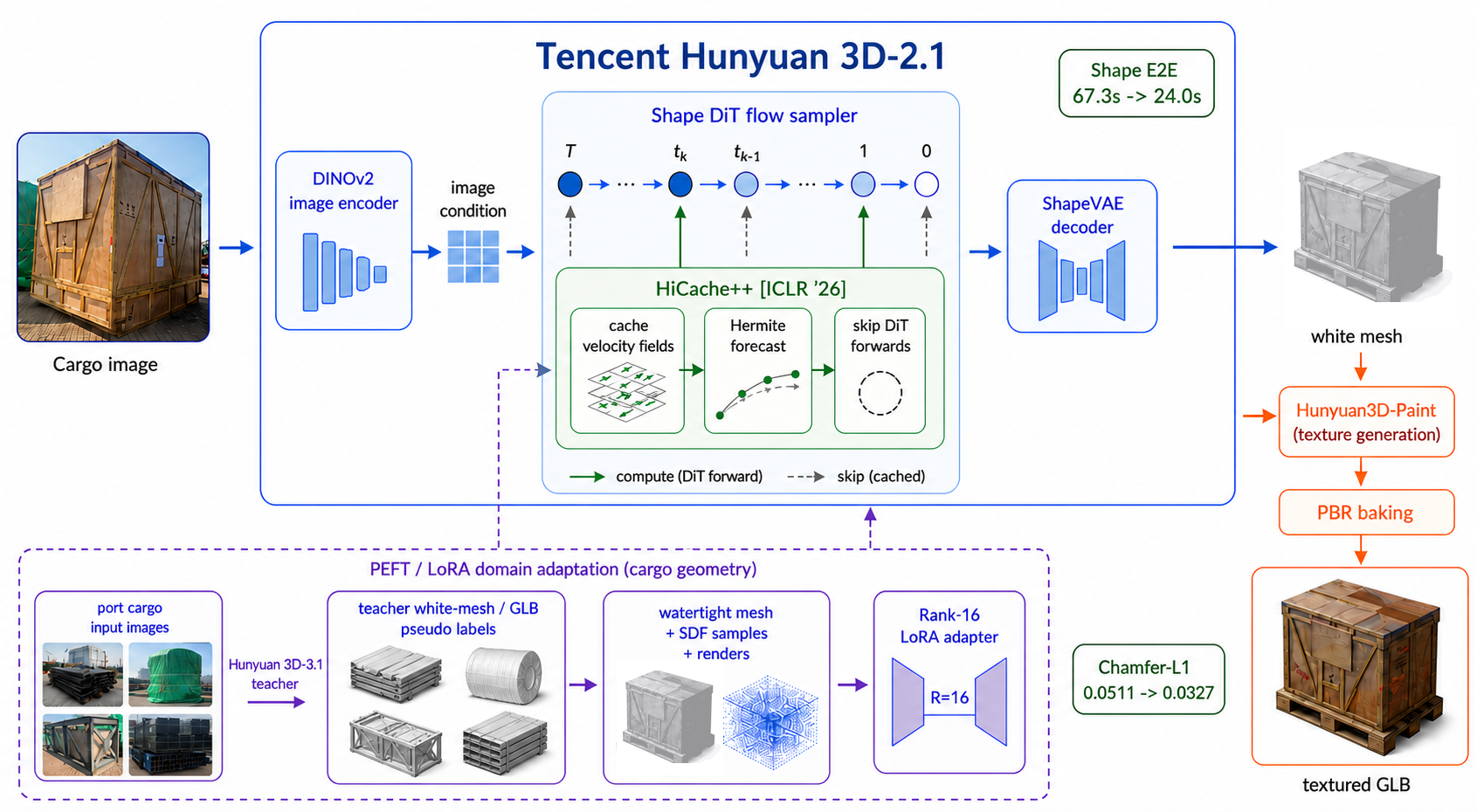
In collaboration with the Shandong Port Yantai Port Science and Innovation Center, this project targets rapid mesh asset generation, MB-level model archiving, non-contact cargo acquisition, and real-scale restoration for port breakbulk cargo digital twins. Based on Tencent Hunyuan3D-2.1, the system builds an integrated workflow covering image acquisition, generative 3D reconstruction, scale calibration, and digital-twin-ready asset export.
For fast white-mesh generation after crane-triggered image capture, I integrated HiCache++ into the Shape DiT sampling loop by reusing historical velocity fields and skipping selected DiT forward passes. On an NVIDIA RTX 4080, the 30-step shape sampling time was reduced from 40 s to 7 s, and the shape end-to-end latency decreased from 67.3 s to 24.0 s, achieving about 2.8x acceleration while preserving the downstream mesh pipeline.
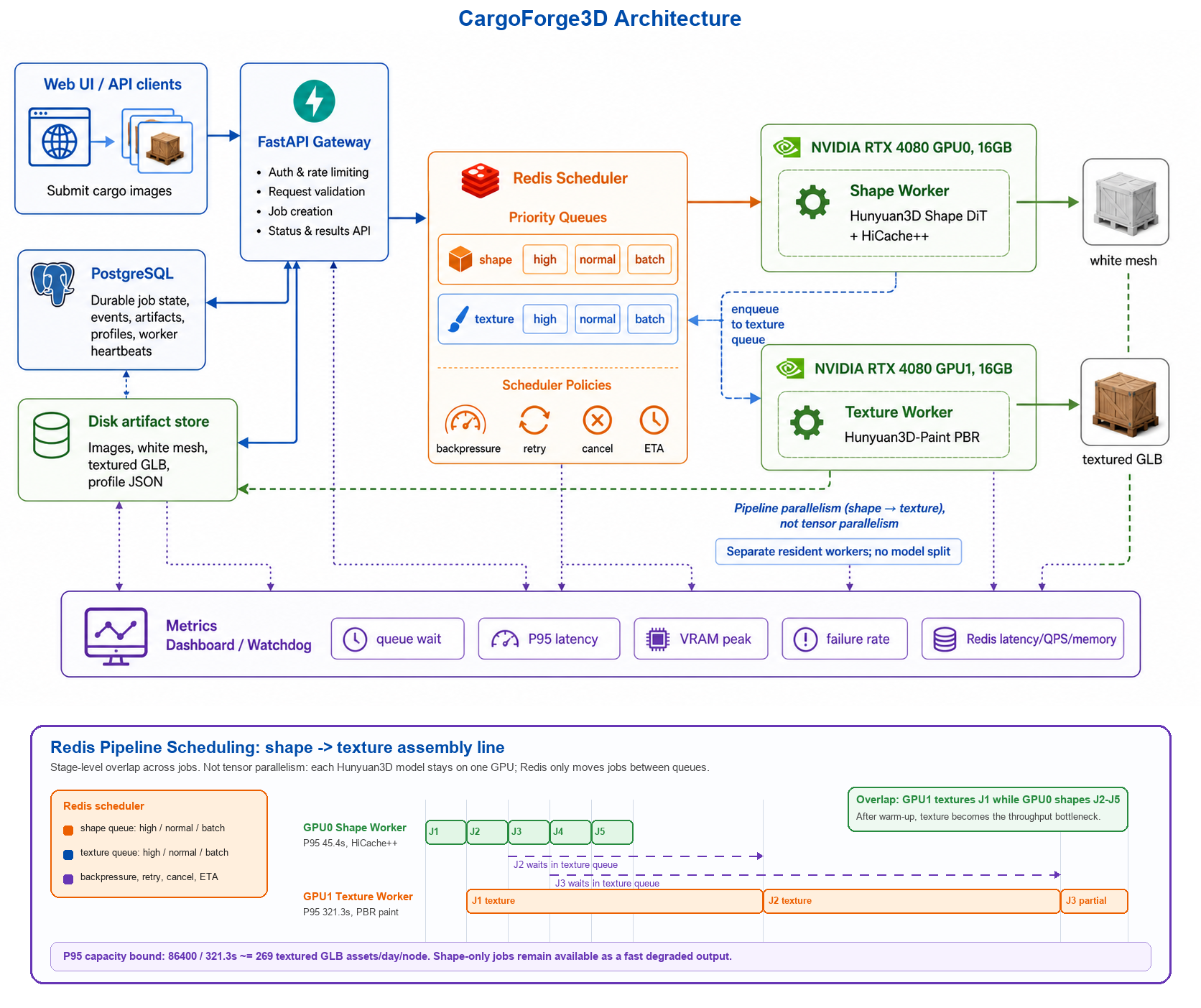
To address the 16GB VRAM limit of a single RTX 4080, I designed a FastAPI + Redis + PostgreSQL asynchronous serving system with separate shape and texture queues. GPU0 runs a resident white-mesh worker, while GPU1 runs a resident PBR texture worker. The service supports priority scheduling, backpressure, retry/recovery, job auditing, artifact tracking, and resource monitoring. The measured Shape/Texture P95 latencies are 45.4 s / 321.3 s, corresponding to about 269 textured GLB assets per day on one dual-4080 node.
To improve Hunyuan3D-2.1 on irregular port cargo, I used Hunyuan3D-3.1 as a teacher model to construct 100 real yard-image / high-quality GLB pseudo-label pairs. After mesh cleaning, watertight conversion, SDF sampling, and multi-view conditional rendering, a Rank-16 LoRA domain adaptation was trained for cargo geometry. On the validation set, Chamfer-L1 decreased from 0.0511 to 0.0327 and F-score@0.05 improved from 0.670 to 0.793.